Friday, October 25, 2013

Out of Broadband poverty : the importance of backhaul networks

Last week our Broadband on a pole solution gave us at best about 2Mb and usually about 1MB and sometimes less.

In the last few days 3 have upgraded their backhaul network (I assume since the signal strength on the router remains the same) and now we get


2 important lessons that I take away


  1. The speed of the backhaul network needs government and regulator attention. I suspect the mobile companies want to do the right thing, i.e. give more bandwidth as that is how they make money, they just need freedom to do it.
  2. Don't wait for B.T. and the Welsh Governent to maybe or maybe not improve your Broadband lot as it will be at least 2 years away and may not do anything at all for you in the next 10.
With some luck the next year should see a kick towards 30MB with 4G without having to make any changes to the solution.

If you read this, live in the south Aberystwyth area and think that is the solution for me, I suggest not using Three. Try EE or Vodafone instead. We don't want to contend, do we.

Saturday, October 19, 2013

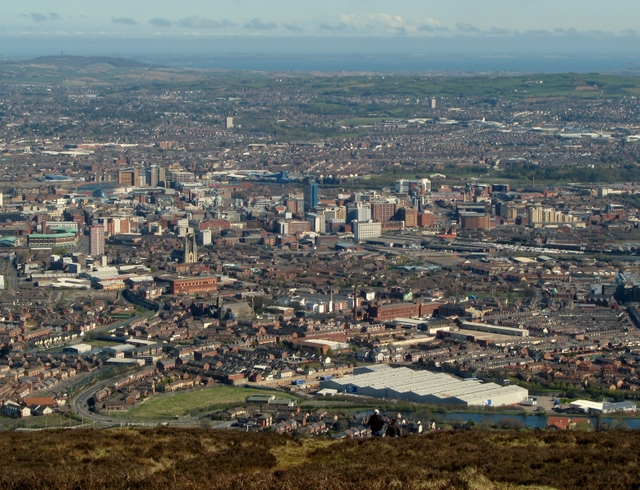
Belfast 28 years on

Just a northern post-industrial town


I last visited Belfast in 1985 for my grand fathers funeral which was probably the most bizzare funeral you can attend on account of packing 9 adult males plus coffin into the hurse for security reasons I still don't understand to this day. A lot has changed since then and it is all for the better.

On Thursday I was part of the British Computer Society Acreditation Panel for Queens University Computer Science. For obvious reasons I can't talk about the visit as the outcome needs to be ratified, but I was very impressed by the overall student experience and in particular by the library complex which is the best student working environment I have seen. If you are visiting Queens, it is well worth a visit.

There is clearly a lot Wales could learn about how to develop a computing sector, but the Welsh Government is unlikely to embrase any of the lessons and to be fair the situation is different.

I was chatting with the taxi driver on the way back to the airport about how different it was since my last visit and he mentioned that people from the north of Ireland, especially youngsters, work harder than their counter parts across the water. I suspect he is spot on.

The only landmark I remember of my previous visit is the Black Mountain and wish I had time for a run up there this week. I shall be taking any opportunity I get to visit again.

Friday, September 20, 2013

Post Office privatisation : should we care ?

The post from counciler Williams here and Alex running a seamless PR machine (again) makes me wonder should we care about the future of the Post Office ?


We are very fortunate our posties (Seems to be a scottish term) are the other end of the spectrum from Postman Plod in quality of Service, though Benny did leave the job to become an undertaker.

I don't hold a view either way as I have no grasp as to the shape of the future ecosystem in which the Post Office (private or otherwise) will operate in when the Universal Service Obligation expires in 2019.
  • To what extent will letters become irrelvant and replaced by email ?
  • What proportion of the bussiness will be parcel delivery?
  • Will there be universal lookup for email addresses for individuals or addresses
  • How far will decent reliable broadband roll out get in rural areas to allow reliable email access
The one thing we can be probably be reasonably confident of  is that any adverse consequences will have a disprporionate adverse effect  on rural areas.

How many peoiple are going to send me a xmas card if it costs double what it costs me to send them one?

Will bills still be sent out by post if I only get delivery once a week? Will pay within 7 days or face a fine still be legally enforcable?

I don't have a good picture of the world of communications in 2019, but I know it will be very different from today. Articulating a view of the shape of communications in 7 years time should be
central to any campaign..... this is why the Post Office is important today and what it will be important in the future. As an investor I would struggle to articulate a business case for the Post Office going forward, but that is the whole point of state ownership to make sure those services which have economic and social benefit, but can't be run for a profit, are provided.

The one principle that propably will hold is that the changes will only improve the lot of those who embrace them and this who don't (or can't) will be adversly effected.

One the plus side it may reduce the amount of junk mail those of us in rural areas get sent.

Thursday, September 12, 2013

My name is Clive and I am not a Map Addict


Front Cover


I meet Mike Parker a few months ago, the book seemed interesting, so it join the "to read" shelf.

As a fell runner, rock climber and long time mountain wanderer, maps are an essential  tool of the trade. There, see, I used the word "tool", so I  can't be  a map addict. I may have various other compulsive behaviors, but none of them involve maps in any capacity other than working out where to go.

My 1st post university job was at the Ordnance Survey in Southamptom. I was not cut out to be a civil servant and I woke up one morning 6 months into my life long tenure in a cold sweat having had a nightmare that I went into work thinking I was still 23, was shocked I had missed the majority of my life and was now being presented with a clock for my retirement at 65 and told to take the rest of the day off. I resigned that morning (I never tried to explain why, don't think they would have understood) and went to work on a farm back home in Wales before getting a most wonderful job in the computer science department at Aberystwyth 3 month later. 22 years on I don't regret in any way taking the dream seriously as an indicator of what my unconscious mind was worried about.

I read this book over about 2 months which is quite quick for me. Mostly a page or 3 at  bed time, some on a train from Boston to NYC and some on a canal boat in north wales.

 What made this book very worthwhile for me was the random, general knowledge that Mike come out with. not about maps, but places maps took him. I don't share his hatred of GPS/satnav, though I don't often use one for driving in the UK. I do use them as a last resort on the hills and on roads in the U.S, but I love both my android phone and Dakota 20.

 Towards the end of the book, it gets more philosophical. I need to get from North to South train stations in Boston, it did  prompt me to  undertake the mile walk Google maps directed, rather than use the metro. I encountered the Freedom Trail and in particular the New England Holocaust Monument, which at the time had profound effect on me at the time, one of those rich, random experiences which an unplanned walks across a city brings.

I am quite sure we see Cader Idris in quite the same way here, or here, though I know what he means about the sense of calm being on the top at night brings. During my Bob Graham addiction, Cader was one of my primary training grounds. Dog and I did 4 reps one day of the route described in the book and it was a different experience , almost felt like a different mountain, on each rep over 8 hours. I certainly have not become a poet as the myth cited in the book suggests and enjoyed just about every moment on Cader.


UK map are the best in the world, but my favorite map is not from my past employer which I say with some regret. Instead it is the Harvey's Bob Graham Round map.


Tuesday, August 20, 2013

Go do it yourself : 3G Broadband solution


Attempting to make a living from doing this computer stuff in rural Ceredigion is only made harder by decisions of previous governments on the way they structured B.T. and of the current governments in both Westminster and Cardiff on their decisions to subidise B.T. to become a Sky Competitor at the expense of business and those who live in rural areas, or just those who B.T. can't make a profit from.
As a family we can't wait until the end of 2015 for a faster service that may not even arrive, no matter how nice the sunset (and you can go for a swim if you think it is OK to suffer bad/no broadband coverage in rural areas. Dont' read on, I forbit it in the same way Johnny Marr forbid David Cameron to like the Smiths).


So, as a backup to our rather slow and increasingly unreliable B.T. line (as the exchange gets busier, service further from the exchange gets worse), we now have a 3G service. It is not super fast for reasons I will explain later, but it is good enough to work on, download low-res video and play ClubPenguin. Biggest performance limiation is the backhaul network.

Under the track

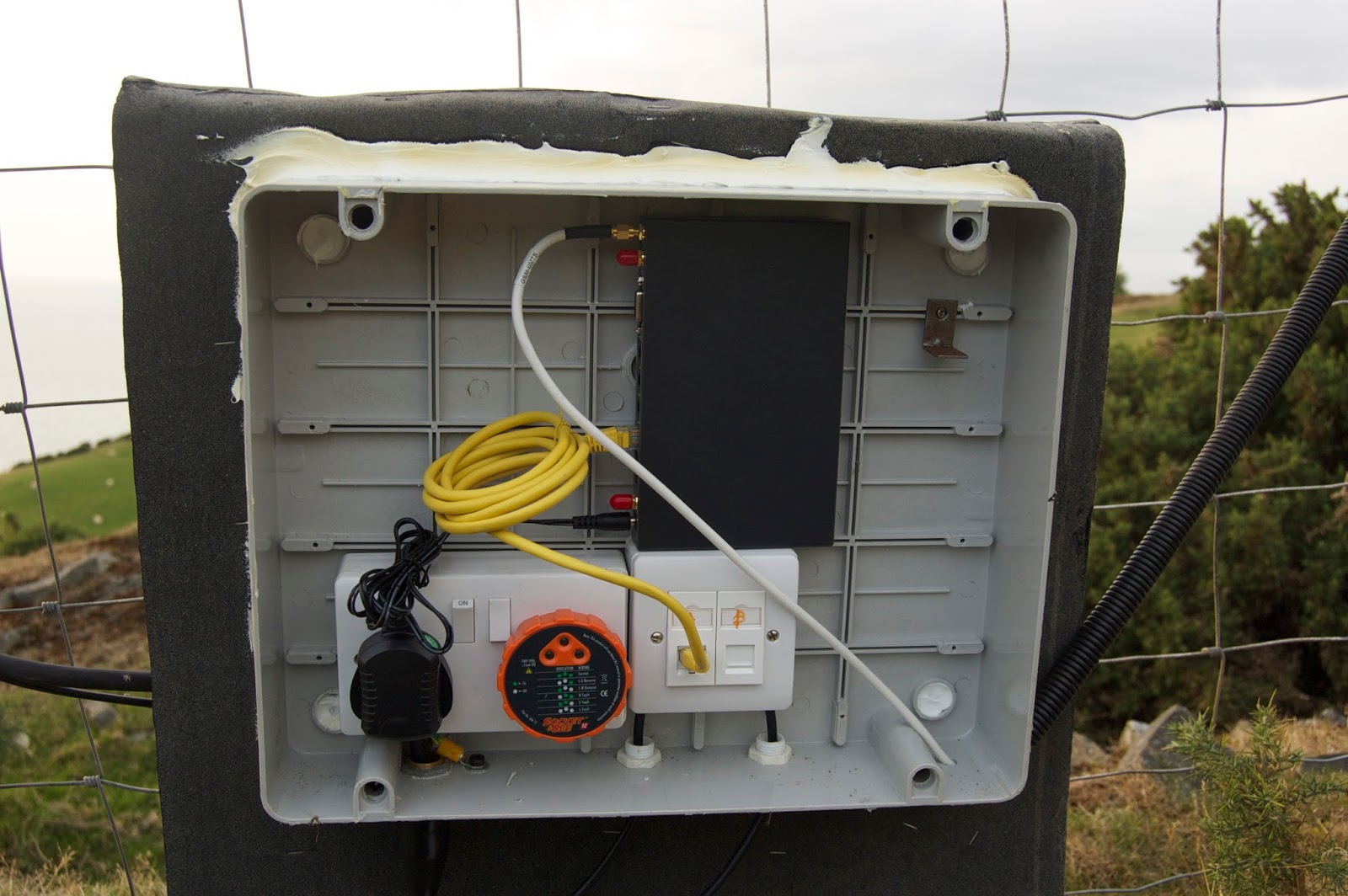
Cable tie quality is important


If it is waterproof here, it is waterproof anywhere!
Getting a 3G service where we live is not has simple as going into a Three shop and buying a MyFi device. We don't have line of sight to the mast, so only get 2G reception (sometimes it is even Vodafone I.E., I joke not), we need to be a bit more creative.  The components of the solution are
  • 83 meter of Armoured Cable
  • 2 x 83 Meters of external Cat-5 cable
  • Adaptable Box
  • Proroute H820 Commercial Grade Router
  • 10DB high gain attenna
  • 3G SIM card 
  • Lots and lots of cable ties 
  • 20m of plastic water pipe (duct for going under track)
  • A pole
  • Odds and ends like Armoured glands, 2 gang socket, cables glands
  • A most excellent farmer as a neighbour who is happy for me to run a set of cables under the road and up his fence
Inside the box

Cheap? No, not really in capital terms, but cheaper than finding an other house with the same qualities and it is cheaper that Sat. without the 1 second latency. It is also in one of the most exposed places in Wales, so the mast does need some more work in terms of strengthening over the next few weeks before the October storms appear.


At the top

We are using Three as a 3G provider on the basis that their transmitter is the highest up the Blanplwyf mast (Where my late Dad worked from 1960 something till about 1985).

Target
We have got 4MB at best, but more usually it is 2Mb or a bit less and we do suffer from a busy backhaul network. The router will cope with 4G if it ever comes this way. Router was easy to set up, has the  largest range of temperates it will work in and gives much better performance than a Telonika 500 I tried. Latency is between 70ms and 100ms, so runs a SunRay fine.

One quite minor issue with the Proroute H820 router is that it gets itself in a twist and needs to be rebooted maybe every 2 weeks. Probably be addressed in a future firmware update at some point.

If we could get the attenna 1m higher, there should be a improvement (we gained 1 bar of reception by going from 2.5m off the ground to 4m  off the ground), but wondering round the fields with a laptop and a dongle suggests there is only about a 25% opportunity for improvement to getting better line of sight.

I also want to try a SIM for different providers as I am not convinced that the Three transmitter is pointing in our direction.

Still better than B.T. and it is here today, required no major technology on our part and I expect 3G speeds to improve over the next year in this area.

Thursday, August 8, 2013

Serious error of judgement Mr Rees-Mogg ?

Other than a quiet poor appearance on "Have I Got New For You",  the little I know about him suggests we have little in common. This BBC article I found interesting, but not for the central line of the article.

Towards the bottom of the article we find

But Labour MP Sheila Gilmore said it was a "serious error of judgement" by Mr Rees-Mogg and said he should make it clear that he did not support the views expressed on the group's Facebook page.

The use of the term "serious error of judgement" has permiated our culture having the effect of scaring us off from having a go incase we make a mistake and are accused of a  "serious error of judgement". A rather more serious chap than either of this pair of clown's^D^D^D^D^D M.P's. would be appauled and its part of why we are in the economic state we are in.

Better Mr Rees-Mogg has at least brought this particular bunch of right of centre clowns into the light.

Given her background I would have expected better from Sheila Gilmore. Jacob Ress Mogg on the other hand it baffles me how someone like this gets elected.

Anyway, watch Sir Ken's TED talk and can you see the link ?

Monday, July 8, 2013

slippage or semantics ?

Don't for a split second think I am cynical of the ability of BT and the Welsh government to deliver on their Broadband commitment.

It is just me or has the date slipped from by the end of 2015 to by 2016  ?

Judge for yourself here

Friday, June 28, 2013

recycle : wales@home pension article

With the sad demise maybe 18 months ago of Wales@home comment web site with some terrific articles about Wales stuff, its time to publish some of the articles I wrote here.

This was my 1st article I wrote and still I think has much worth saying which is still true 2 or 3 years later.  Reproduced here without the nice picture of the piggy bank !

I used it as a template for a presentation to a Professional Pensions conference in Manchester, it really did not go down well which I think was a valid result.


Choose a pension
Choose absolute return, multi-asset, a fund of hedge funds and 5% bid offer spread.
Choose from 1500 funds, none of which you have a clue as to how they work.
Choose lifestyle, drawdown or inflation linked annuities with matching whole of life cover.
Choose procrastination induced by choices you don't understand.
Choose an ill informed I.F.A. for 120 quid an hour and wonder who the pensions industry is set up to serve.
Choose mind numbing, all inclusive disclaimers to read and sign.
Choose your capital being slowly eaten away by commission, administration, dealing and management fees.
Choose a history of scandals, mis-selling and an industry hiding behind a raft of
opaque jargon and poorly understood legislation.
Choose a pension.

A work colleague chose something else. At 39, he does not expect to
draw a pension and makes no contributions. A conscious judgment based
on his current state of health and age of death of his male
relatives. A rational choice?  Maybe, but he is not alone. For their
own reasons, half of UK 35 year old workers make no pension provision.

Good reasons abound to be cynical of the UK pension eco-system, but
there is also much to commend. Millions in retirement are benefiting
as pension funds and insurance companies pay out and the state still
provides a modest pension.  Backed by a Pensions Regulator with sharp
teeth, governance standards in UK company pension schemes are now very
high and robust against fraud, with lessons learned from past scandals
such as Maxwell and Equitable Life. Giving and marketing of financial
advice to consumers is well regulated. The better off can access a
huge range of investment choice. The well informed can access
efficient low cost savings vehicles. Tax treatment on pension
contributions is very favorable. Company schemes funding against
liabilities is well understood and the Regulator takes action on
excessive deficit levels. Some fund managers are becoming more active
as shareholders on issues including executive pay. Blackrock, for
example, holds regular meetings with Amnesty International to
understand risks around working conditions for companies and countries
they invest in. The UK pension industry may be a few actuaries short
of fully funded, but the case to use a pension as the core of
retirement saving is still compelling.

The Royal Society of the Arts published a damming report in December 2010 
which makes my Trainspotting parody
sound positively glowing by comparison. The executive summary
commences with

        "The system of occupational and private pensions in the
      UK is not fit for purpose. It is not the low cost,
      trustworthy system which savers justly demand." 

Pension funds in the Netherlands pay out around 40% more on retirement
than their UK counterpart, courtesy of lower commission and management
charges on contributions. The difference funds a well rewarded army of
advisers, consultants, actuaries and fund managers. Complex and
outdated legislation stifles innovation and transparency. The tax
treatment of pension contributions is regressive, with the better off
gaining proportionally more.

The media reported pension crisis is today centered on scheme funding
levels and the balance of contribution between employer and
employee. Expect a gradual worsening of the pensioner crisis as some
outside final salary schemes must work to the grave, or have an
unexpected retirement in poverty, as their pension provision falls far
short of expectations.

Final salary pensions, the mainstay of large company and public sector
schemes, are undergoing well publicized changes. These include
shutting schemes to new members, moving to career average final
benefits, increasing member contributions or and offering a hybrid
of defined benefit and defined contribution.  UK company schemes are
collectively in deficit by 189 billion (85% funded) as of November
2010. The figure hides a huge variation in both deficit and company
support.  For example, the B.T. pension scheme has a deficit of around 9
billion. Part of a plan to plug the gap involves an agreement with
B.T. to pay over 500 million a year for the next three years.  Money,
in theory, which could have improved the UK's telecoms infrastructure
if no deficit existed.

In 2012 ten million workers currently with no pension will be
auto-enrolled and have contributions taken from salary unless they opt
out. A second development, positive for those currently
disenfranchised by the cost and complexity, is the National Employment
Savings Trust (N.E.S.T.). A not-for-profit investment organization,
set up to provide a low cost investment option for the lower paid,
self employed or employed by an S.M.E. N.E.S.T. has inherited a number
of handicaps courtesy of industry pressure, including a ban on
transferring in other pension fund pots and a payment limit of 3600
pounds a year.

In excess of 23 trillion dollars is invested in global pension funds,
with the UK pension funds holding around 2 trillion dollars. Where they
invest has a significant effect on the overall economy, from the price
of government borrowing to the availability of private equity
funding. Providing capital for green energy or infrastructure could
realistically play a larger part than it does today, benefiting both
pension savers and society.

Will increased tuition fees cause more indebted graduates to delay
making significant pension contributions until their forties thus reducing
the impact of the universes most powerful force according to Einstein,
compound interest.

One underlying cause of the ongoing western financial crisis is
deficit driven from consumption funded by Eastern savers. Reducing our
expectations and consumption, instead saving a higher proportion of
income is a tough sell. For this reason alone, good value, attractive
pensions schemes for all are critical and urgent.

If I were the 2011 new year pension fairy, the one change I would gift
to all elected politicians who take pension contributions from the tax
payer is a restriction that at least 50% will be invested in N.E.S.T, or
Group Pension Plans. My inner optimist wants to believe that by
having real skin in the game, the pensions industry would
be bludgeon to move beyond the myth that ever greater consumer choice
is sufficient.  Successful pension saving requires government,
employers, the pensions industry and the individual in equal measure
to take responsibility.

----

Dr. Clive King was born and brought up near Aberystwyth. Returning
after study and work in various parts of the UK, he lives with his
family in a small rural village. He has worked for global computer
systems companies for the last 15 years solving technical problems
worldwide. He is a Fellow of the Department of Computer Science at
Aberystwyth University, a Member Nominated Trustee of a large company
pension scheme and a past acting Chair of a Citizens Advice Bureau
branch. He is currently engaged in a mid-life crisis of completing the
Bob Graham Round. He writes in a personal capacity.

Sunday, June 2, 2013

Metor Crater Arizona : reseting my assessment of the probability of the improbable

I spent the last 2 weeks on a customer site in Phoenix, Arizona and had a free weekend. Saturday did a rim to river to rim in a day in the Grand Canyon (see ambitionexceedsability blog) and on Sunday went to Metor Crator in northern Arizona. I was the 1st in through the gates on the sunday morning, had quick look at the crater, took some pictures and was sitting in the film theater waiting for the film about how the earth might get destroyed by a metor impact, happy stuff. I was in a little world of my own thinking about the technical issues that I had been working on at the customer site about 150 miles south.

2 chaps walk into a film theater with a capacity of about 200 people and pick the seats right in front of me. One who looks very much like someone I know called Jon who is with someone who looks very much like Ed I know, looks at me, does a double take and then says "sorry, you look just like someone we know".


So lets do a rough guess at the probability of meeting this pair in the middle of the desert. I had no idea they were even in the US
The components I can think of are

  • Chances of Clive being in Arizona during a weekend : 1 in 500 (take the last 5 years as a guide, I have only been to Arizona once)
  • Chances of Jon and Ed being in Arizona at a weekend as part of a road trip from San Fransicso : assume the same
  • Chances of being there at the same time over a weekend : 1 in 100 (16 hours open over weekend = 256 hours, but should be skewed higher as we are likly to visit at start or end of day)
  • Chance of sitting in front of me in the theater (it was big enough to miss each other): 1 in 4
  • Chances of Clive visiting Metor Crater during a weekend in Arizona : 1 in 4 (I only decide to visit it about 1 hours before I meet them, I saw it on the map and thought that looks interesting. I could very easily have gone the other direction to see something else. My original plan was to go into the Grand Canyon on both days of the weekend.
  • Chance of Jon and Ed visiting Metor Creater during a weekend in south west US : guess at the same 1 in 4.
so that give a simple probability of around 1 in 1,600,000,000. I suspect  some curious bayesian influence are at play where the probability of meeting is in reality much higher.

We can assume a higher liklyhood as Jon and Clive share a subset of interests in things astronomy, so are likely to visit the same sort of areas. I guess I might know 100 or so people as well as I know Ed and Jon, so maybe the probably should be meeting someone I know well (whatever that is defined as).

Either way it would be a struggle to fudge the simple probability down to less than 1 : 1,000,000.

If anyone would like to comment with a pointer on how to calculate a more realistic probability, please do.

This does show that the probably of being found out is you are doing things you are not meant to is far higher than you think !

Thursday, March 28, 2013

Boris, startups and twitter

Boris says ....

35m
Happy 2nd birthday to - 75% of all start-ups last year were registered in London making us the enterprise capital

London doing well or the rest of the UK doing badly ?

With only about 10% of the UK population, I suspect the later.

What could be happening. I suspect a  combination of

  • Brain migration from outside the rest of the UK
  • Entrepenurial immigrants set up in London rather than going elsewhere
  • The rest of the UK is less fertile for start-ups - it is just harder to hire,get funding, etc
It should be a serious wake up call to Council leaders, Boris is making fun of you on twitter. How many County or City councilers would never have used Twitter or even know what it is[ I know at least 2 in Ceredigion]. I suggest it is probably a good proxy measure for the amount of support a startup in a region would get.